Blog
Tips, strategies, and insights on productivity and time management.
How to Plan Your Day the Night Before (The 15-Minute Evening Routine)
A repeatable end-of-day ritual that makes mornings calm and days focused — with or without an app.
The most productive people don't start their morning by deciding what the day should be. They start with the plan already made. That isn't a personality trait. It's a 15-minute ritual they run the night before.
This article is that ritual: brain dump, pick your top 3, time-block them, fit in the rest honestly, review, and shut down. You can do it in a notebook, in Apple Calendar, or in an app. The method is the same.
If you want the broader method this sits inside — why time blocking works, how to estimate durations, how to recover when a day collapses — read the complete time-blocking guide. What follows is the daily keystone: how you close today and open tomorrow.
Why plan the night before?
Morning-you and evening-you are not the same person.
Evening-you still remembers what slipped, what took longer than it should, and which meeting ate the afternoon. The day's friction is fresh. You can make honest calls about tomorrow because you just lived a version of it.
Morning-you is in execution mode. You've slept, the inbox is already humming, and the first message arrives before coffee. Planning in that state is strategy work under time pressure. You either rush it and overcommit, or skip it and spend the day reacting.
There's a named finding behind the "open loops" feeling. The Zeigarnik effect: unfinished tasks stay more active in memory than finished ones. You don't need a paper to recognize it — it's why a half-written email follows you onto the pillow. Writing the loop down and giving it a place tomorrow is how you let it go for the night.
Cal Newport's shutdown ritual is the same idea with a harder edge. At the end of the workday he reviews open tasks, makes a plan for the next day, and uses a shutdown phrase so his brain has permission to stop. The 15-minute evening routine is a shutdown ritual that also produces a calendar you can actually follow.
Planning at night also buys you something mornings never will: a night of sleep on a decided day. You wake up knowing the first block. No blank page. No "what should I do?" as the first decision of the morning.
The 15-minute evening routine, step by step
Set a 15-minute timer. When it ends, you're done. The constraint is the feature — this is a ritual, not a second work session.
- 1
Minutes 1–3
Brain dump
Get every open loop out of your head.
- 2
Minutes 4–6
Top 3
Pick the three things that make tomorrow a win.
- 3
Minutes 7–10
Time block
Give each top-3 item a start time and a duration.
- 4
Minutes 11–13
Fill the gaps
Fit the rest honestly — or leave it off.
- 5
Minutes 14–15
Review
Scan tomorrow, then shut down.
Minutes 1–3: Brain dump
Write down everything still on your mind. Work, personal, errands, the text you owe, the invoice, the thing you told yourself you'd "remember tomorrow." Don't organize. Don't estimate. Don't decide if it belongs on the list.
The dump is a transfer, not a plan. You're moving open loops out of your head so the next steps can be honest. If you skip this and jump to "top 3," you'll pick from whatever is loudest, not from everything that's true.
A notebook works. A notes app works. A to-do inbox works. Speed matters more than the tool.
Minutes 4–6: Pick your top 3
Look at the dump and ask one question: if I only finish three things tomorrow, which three would make the day a win?
Not the most urgent. Not the most emails. The three that move something real — a project, a relationship, a body of work, a commitment you keep avoiding.
Three is the constraint. Four is a list again. If everything is a priority, nothing is, and you'll time-block a fantasy.
Write the top 3 where you'll see them in the morning. Then ignore the rest of the dump for a minute. You'll come back to it.
Minutes 7–10: Time block your top 3
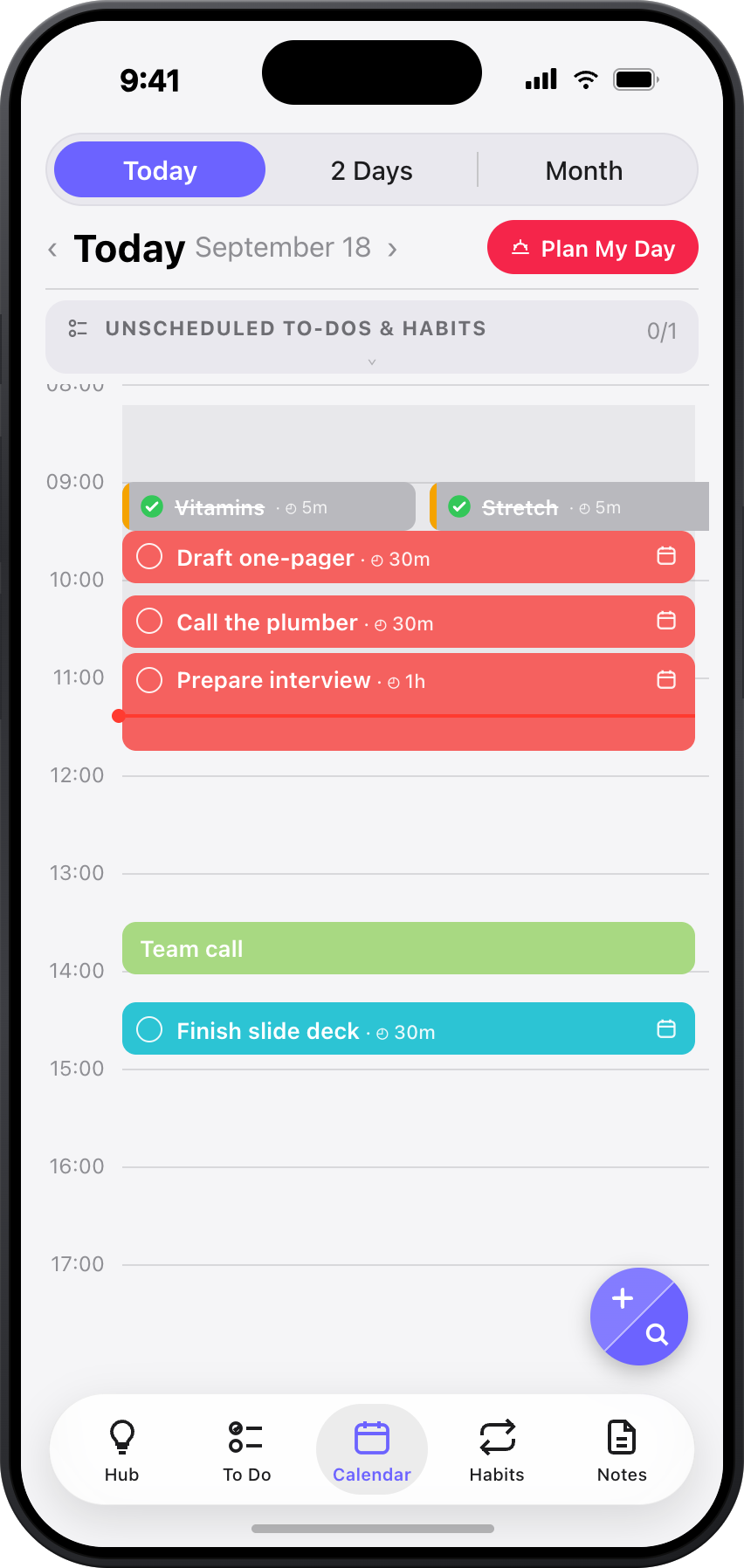
Open tomorrow's calendar. Place each of the top 3 as a real block — start time and duration.
Be rude to your optimism. If "write the proposal" always takes two hours, block two hours. Put the hardest one in your peak energy window (for most people, the first long stretch after you actually start working — not the first twenty minutes of inbox).
Existing meetings stay. Your top 3 go in the gaps that can hold them. If a top-3 item doesn't fit, you don't have a top-3 problem. You have a calendar problem, and you just discovered it while you can still say no, reschedule, or shrink the work.
This is the step that turns intention into a schedule. A list says you'd like to. A block says you will, at 9:30, for 90 minutes.
Minutes 11–13: Fit in the rest — honestly
Now the leftover dump. Admin, errands, the 15-minute replies, the gym, the grocery run.
Fit them into leftover gaps. Batch the shallow work. Leave buffers. Do not invent a 26-hour day.
Anything that doesn't fit in the calendar doesn't fit in the day. That's the whole point. Move it later in the week, drop it, or admit it's a wish. The honesty is the productivity.
If your calendar is a solid wall from 8 to 8, you didn't plan. You wrote fiction. Pull work off until you can see white space.
Minutes 14–15: Review tomorrow and shut down
Scan tomorrow once. Meetings confirmed? Buffers real? First block something you can start without a decision?
Then shut down. Close the list. Close the calendar. If you use a shutdown phrase, use it. The ritual isn't finished until your brain is allowed to stop rehearsing the day.
Sleep is part of the method. A reviewed plan is how you earn it.
When the plan blows up anyway
It will. A meeting overruns. A kid gets sick. A "quick question" becomes an hour. Time blocking that can't survive contact with Tuesday isn't a method — it's a mood.
When the plan blows up: replan, don't abandon. Cross out the block that died. Look at what's left of the day. Keep the most important remaining top-3 item if it still fits. Move the rest. The evening ritual tomorrow will catch what slipped.
People quit evening planning because they treated the calendar as a contract. Treat it as a hypothesis you update. The win is not a perfect day. The win is never starting from zero.
Morning planning isn't wrong — it's just second best
If you missed last night, plan in the morning. Ten imperfect minutes before the inbox is better than no plan.
It's second best for three reasons. You have less information about yesterday's leftovers. You're already in execution mode, so you'll under-think the top 3 or over-pack the calendar. And you spend the first energy of the day on strategy instead of the first block.
Some people prefer mornings and stick with it. Fine. The load-bearing idea is the same: decide the day before you start reacting to it. Night is just when that decision is cheaper.
How to make the routine stick
Anchor it to something you already do: after you shut the laptop, after dishes, after you set the alarm. Same place, same 15 minutes, most nights. Missing one night is normal. Missing four is a drift.
Keep the tools boring. If the ritual requires opening six apps, you will not do it when you're tired. One list, one calendar, one timer.
Track the streak lightly if that helps, but don't turn the ritual into a performance. The point is tomorrow morning, not a perfect chain.
Do it in 2 minutes with ToBlock's Plan Tomorrow
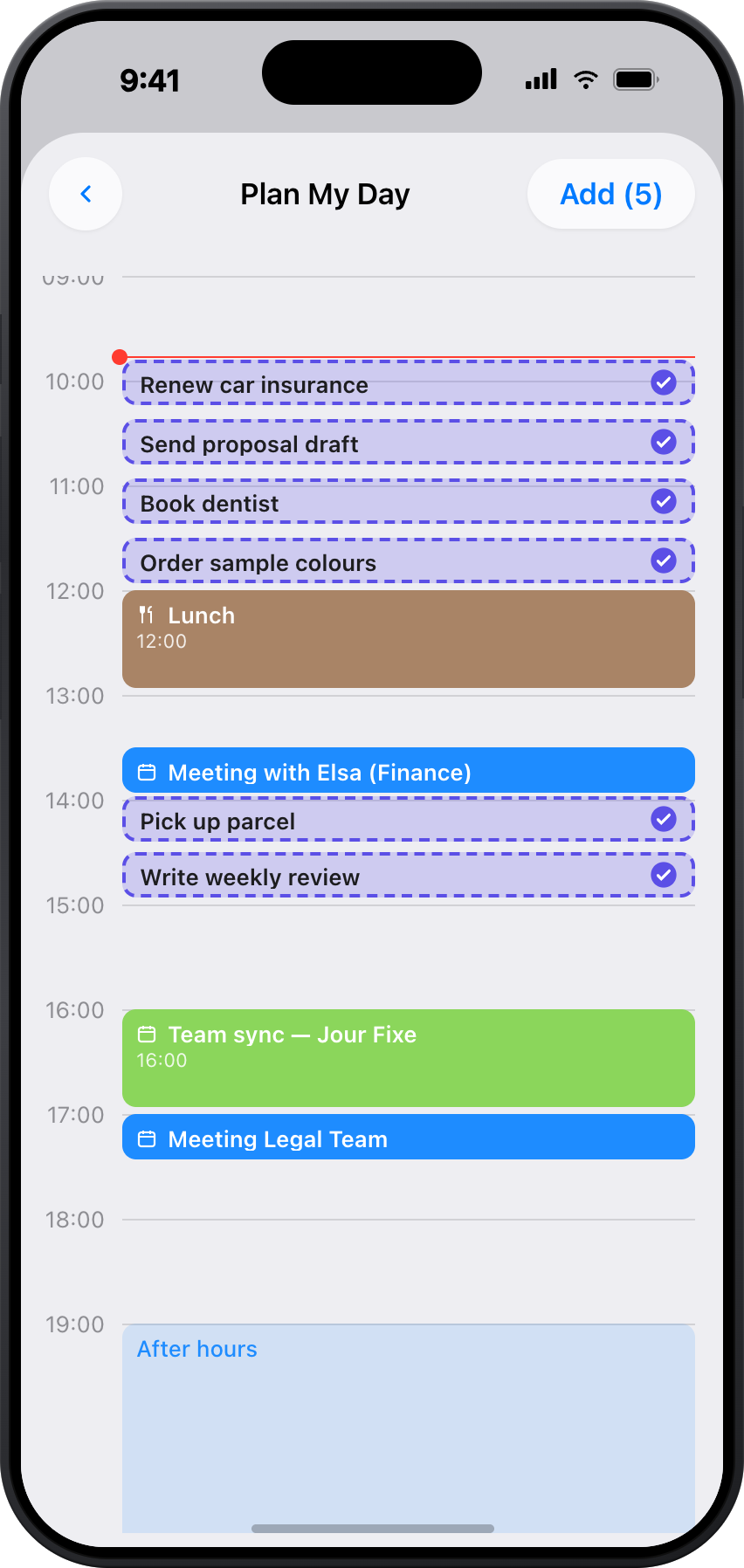
ToBlock's Plan Tomorrow is the fastest version of the same ritual — not a replacement for thinking, and not a claim that the whole thing runs itself.
It walks you through unfinished tasks, helps you pick what moves to tomorrow, and time-blocks those choices straight into Apple Calendar. About two minutes if your list is already there. You still choose the top 3. The app removes the friction of rebuilding the day by hand.
The hardest part of any ritual is remembering to start. ToBlock can remind you in the evening and open the right view so you're not staring at a blank calendar.
The weekly version
Once a week — Sunday evening works for a lot of people — spend twenty extra minutes looking at the next five days, not just tomorrow. Place the big rocks (deadlines, deep-work sessions, personal non-negotiables) before the week fills itself. Daily planning then becomes adjustment, not invention. You don't need a separate product page for this. Same dump, same honesty, wider window.
FAQ
Why plan the night before instead of in the morning?
Evening-you still remembers what slipped and isn't in execution mode yet. You also get a night of sleep on a decided day, so morning-you starts with the first block instead of a blank page.
What if I only have five minutes?
Run a compressed version: dump for one minute, pick one top thing, block it, scan tomorrow. A partial ritual beats skipping. The 15-minute version is the full form, not a minimum.
Does this work with Google Calendar?
Currently ToBlock time-blocks into Apple Calendar on iPhone. If Google calendars are added to the iOS Calendar app, they show up there too. The notebook-and-calendar version of this ritual works with any calendar you actually look at.
What should I do when the plan blows up?
Replan the remainder of the day — don't abandon the method. Keep the most important remaining top-3 item if it still fits, and let tomorrow's evening ritual catch what slipped. If every day blows up, your blocks are too tight.
Do I need an app to follow this routine?
No. A notebook and a calendar are enough. An app helps when the pain is friction: capturing leftovers, placing blocks, being reminded to start. ToBlock's Plan Tomorrow is the fastest version of the same ritual, not a replacement for choosing your top 3.
TL;DR
- Plan tomorrow tonight, not tomorrow morning. Morning-you is in execution mode, not strategy mode.
- 15 minutes: brain dump → top 3 → time block → fill the gaps → review.
- Anything that doesn't fit in the calendar doesn't fit in the day.
- When the plan blows up, replan — don't quit.
- ToBlock's Plan Tomorrow runs the same ritual in about 2 minutes and puts it into Apple Calendar.